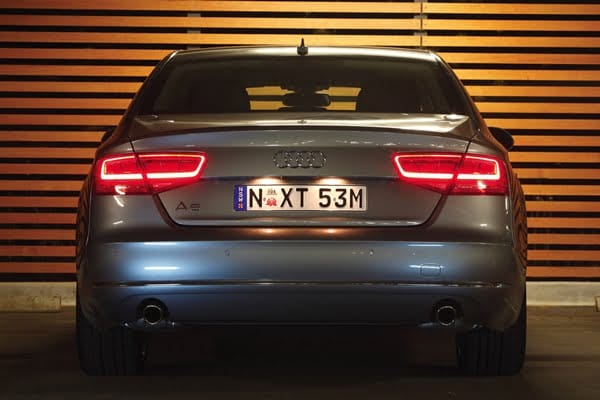
Audi A8 3.0 and 4.2 TDI Review And specifications
Local Launch
Daylesford, Victoria
What we liked>> Refined and capable V6 matched to ZF box
>> Well priced entry-level model
>> Handwriting recognition
Not so much>> Ergonomics
>> Nondescript styling
>> Marginal room in the rear
Overall rating: 3.0/5.0Engine/Drivetrain/Chassis: 3.0/5.0
Price, Packaging and Practicality: 4.0/5.0
Safety: 3.0/5.0
Behind the wheel: 2.5/5.0
X-factor: 2.5/5.0
About our ratings
OVERVIEW-- New diesel variants lead the wayAudi has introduced two new diesel variants to its A8 range -- and one in particular has upset the apple cart. That car, the A8 3.0 TDI, is powered by a cracker of an engine and is priced around $10,000 below even the Jaguar XJ diesel, let alone the BMW 730d and Mercedes-Benz's newly released S 350 BlueTEC.
Priced as keenly as it is, the V6 diesel version of the A8 also makes the formidable technology -- for which the Audi flagship is known -- accessible to a new stratum of luxury car buyers. An impressively advanced engine in the A8 is coupled to a new eight-speed transmission from ZF; the leading edge automatic also a feature of the V8 TDI model.
The two new variants appeal to those who not only can afford the price, but are concerned for the environment. It must be said however, there is a price to pay beyond the cost of purchase. That price is the A8's styling, which doesn't lead the way forward in its class. In fact the A8 from the front is easily mistaken for the current A4, a car already two years old and two sizes smaller than the range-topper. Can all the features and benefits of the A8 -- with the diesel engines too -- compensate for a car that blends into the background?
PRICE AND EQUIPMENT-- Competitively priced and equippedAs mentioned above, the new entry-level A8 is the A8 3.0 TDI, priced at a startling $188,000 -- startling, because that's $10,000 less than Jaguar charges for the similarly sized and specified XJ Premium Luxury diesel.
Standard features fitted to the A8 3.0 TDI include: Audi Drive Select, alarm, rear-view camera with parking sensors, electrically-adjustable electrochromatic exterior mirrors (folding), keyless start/entry, four-zone climate control, walnut brown veneer, 22-way adjustable electric front seats with memory function, Valcona leather trim, 10-speaker audio with USB/MP3 compatibility, Bluetooth connectivity and MMI satellite navigation with hard disc.
Positioned above the V6 model but released at the same time, the V8-engined A8 4.2 TDI is priced at $234,500 -- the same figure Audi charges for the petrol V8 equivalent, the A8 4.2 FSI.
Audi has specified the following standard features for the A8 4.2 TDI, in addition to the V6 model's equipment list: a BOSE 19-speaker audio system, TV tuner, an ambient lighting package, automatically-sealing doors, powered boot lid and adaptive headlights.
MECHANICAL-- More performance without penaltyDiesel powerplants in large luxury sedans must reach the very summit of drivetrain refinement -- no easy feat for compression-ignition engines. Audi has managed to achieve that though, with the two new diesels, both of which are also respectably frugal.
The V6 develops power and torque outputs of 184kW/550Nm and the V8 is good for 258kW/800Nm. Audi has tuned the V6 to delivery peak torque from 1500rpm up to 3000rpm. Similarly, the development team working on the V8 have optimised torque across a range of engine speeds from 1750 to 2750rpm.
The combination of strong power and abundant torque propel the A8 3.0 TDI to 100km/h from rest within 6.1 seconds. For the V8 variant, the time is reduced to 5.5 seconds. In combined-cycle testing official fuel consumption figures are 6.6L/100km for the V6 and 7.6L/100km for the V8. Based on the same cycle, CO2 emissions for the V6 are 176g/km and 199g/km for the V8.
According to Audi, the new V8 weighs less than the diesel V8 powering the previous generation of A8. Both engines displace 4.2 litres, but the new engine is 19 per cent more efficient and outstrips the older engine for power and torque by an extra 18kW and 150Nm respectively.
It's a similar story for the V6: 22 per cent more efficient than the earlier 3.0-litre TDI engine and "class-leading" CO2 emissions. A standard auto-stop/start system reduces fuel consumption while the car is waiting for the lights to change and Audi estimates that this alone shaves 0.4L/100km off the car's combined-cycle figure. The improvement is greater still in city cycle testing.
Like the V8, the V6 has also gone on a diet, its weight reduced 23kg to 194kg. Fuel efficiency is also aided by the eight-speed ZF automatic transmission that drives to all four wheels through Audi's quattro drive system. The wheels themselves are seven-spoke, 18-inch alloys for the V6 variant (with 235/55 Pirelli tyres) or 10-spoke, 19-inch alloys with 255/45 Pirellis for the V8 model.
PACKAGING-- Overpowering inside, underwhelming outsideOne point of criticism directed at the new A8 since its release has been its homogenous style. Viewed from directly ahead the A8 could be easily mistaken for a smaller car in the Audi range, like the A4, for instance.
Along the flanks it shares visual traits with the Volvos of Peter Horbury and the BMWs of Chris Bangle. As a design, it ultimately lacks the distinctiveness of Ian Callum's Jaguar XJ, leading to the obvious question: What makes Audi designers think that A8 owners want to blend in with the crowd?
Also, by contrast with the Jag XJ, the instruments and controls in the Audi get pretty busy at times and they're not exactly intuitive to use, between the sheer number of switches and the two-fold labelling of each -- text and graphics.
Two minor dials reside in the instrument binnacle. The fuel gauge is in the lower right corner and the engine temperature gauge is in the lower left. On first glance they appear to be analogue instruments, but neither uses a needle to indicate the fuel remaining or engine temperature, respectively. Instead, they use a series of LEDs around the dials and these illuminate progressively to indicate the measurement. Unfortunately, both can be swamped by bright sunlight glare.
We tried the touchpad to write a destination for the sat nav. It does certainly recognise hand-scribed letters -- and it’s great technology in isolation -- but using the conventional rotary dial to select letters seems faster -- particularly when most drivers (in a right-hand-drive car) are right-handed and would need to use their left hand to write.
Audi boasts that its driver's seat offers over 20 different modes of adjustment. There's a rotary knob near the forward corner of the seat base that brings up all those adjustments in the MMI display screen in the centre console. That fine-adjustment feature -- to make changes other than slide, recline and height -- has actually redeemed itself since the Carsales Network first drove a petrol V8 variant of the A8, providing ease of adjustment for such things as side bolsters, length and tilt of base cushion, lumbar and seatbelt anchorage height. Once you know how to use it, it does make the process of setting up the driving position simpler and faster.
Rear-seat accommodation was not ultimately as roomy as in even the short-wheelbase Jaguar XJ -- the last car in this class driven by the writer. Our co-driver felt it was marginal against the BMW 7 Series as well. There's plenty of headroom in the rear and the knee room is adequate for adults, but there's just not the same room to stretch out as in the two competitors.
SAFETY-- No NCAP judgement?For a full run-down of the A8's safety accoutrements, read our international launch review, but in brief, the flagship offers the active safety of quattro all-wheel drive and other safety features like xenon headlights, a sports differential (optional for the V6, standard for the V8), ABS/EBD, Brake Assist, stability control, traction control and an electronic differential lock.
Standard secondary safety features include two-stage front airbags, side-impact airbags front and rear, side-curtain airbags and active headrests.
As a final note, it's well known that a five-star NCAP score is practically a matter of form for Audi models, but the A8 hasn't been tested by Euro NCAP.
COMPETITORS-- A8 in the middle of the packFor Audi, the A8's competitors are a pack of marathon runners. There are clearly two front-runners Audi has in its sights: the BMW 7 Series and the Mercedes-Benz S-Class. And there are a couple of followers, the Jaguar XJ and the Lexus LS.
We say that the field is running a marathon because the S-Class is very hard to haul in, despite the 7 Series puffing and panting away for years. Last year, the 7 Series did actually pull ahead of the S-Class in sales, although Benz attributes that to lack of supply. If the BMW is finding it hard, it's even tougher still for the A8 to keep the leading two in sight.
Like the A8, the Jaguar XJ features aluminium construction, but is even lighter still. Plus, its 3.0-litre twin-turbo V6 diesel produces more power and torque. Add to that the Jaguar's (polarising) style and buyers might begin to question whether the $10,000 price disparity is as cut-and-dried as it may appear.
The Lexus is not available with diesel power, but you can buy the car with a hybrid-drive system (the LS 600hL). Beware though, the boot space in the Lexus is pitiful.
Buyers considering the A8 with the petrol V8 might also look at cars such as the BMW 5 Series Gran Turismo and perhaps the Porsche Panamera if rear-seat accommodation is not a major consideration -- and Porsche also has a hybrid version of the Panamera ready to go.
ON THE ROAD-- More a cruiser than a bruiserThe diesel V8 in the A8 4.2 is a pleasantly refined motor, as it should be, being a V8. It will pull strongly without sounding blatantly diesel, but is slow to respond to the right foot on occasion. Such occasions would include a standing start or jumping on the throttle for rapid overtaking where there's a second of delay when called upon to give its all. Fuel consumption for the V8 over the course of the drive program was 9.4L/100km.
No complaints or qualms with the eight-speed ZF box; it works with the typical smoothness and immediacy expected of products from the German transmission specialist. Our one gripe was the shift handle (once upon a time called a 'T Bar'). It's not as stylish as BMW's equivalent, not as functional as Benz's and not as easy to use as Jaguar's. Finished in faux woodgrain, it looks a bit chintzy and it took about three goes to find Reverse, the driver managing to find Neutral and Park first. Sure, owners will get used to it, but there are better devices around for achieving the same ends. Audi mounts another argument: that it also provides a hand rest for using the touchpad.
The V6 engine (with auto-stop/start) lacks the V8's ultimate power and torque, but it's not as far behind as the 1.2-litre difference would suggest either. Nor is it especially thirsty. Audi is entitled to take credit for the car's 'heavy' reliance on aluminium for better than normal fuel consumption, given the car's specification. Admittedly subject to a fairly easy run in the Victorian countryside, the A8 with the diesel V6 returned a fuel consumption figure of 7.8L/100km. Around town expect it to be considerably more than that perhaps, but the auto-start system operated to specification and didn't shake the fillings loose when shutting down or restarting -- although it's still plainly a diesel engine when brought back to life.
Once beyond idle, however, the V6 works hard, but without sounding shrill or labouring at lower revs. It's quite refined and will also rev to 5000rpm when called to do so. The V8 is calling it a day at 4500rpm.
Both engines suffered from turbo lag. As long as the driver built up engine speed with progressive throttle it wasn't a problem, but suddenly dumping fuel into the engine won't give you the immediate thrust you might expect -- although the difference is perhaps just a second of lag.
The heavier steering in Dynamic mode, using Audi Drive Select, makes the A8 seem to push more through corners, but in Comfort mode it still holds the road well, although in tighter corners the A8 pushes more than expected with the power applied. Power off, it approaches neutral. We also found that bumps could throw the vehicle off line in tighter turns and there was even an instance of rack rattle briefly. The A8 is definitely happier in wider-radius bends.
Audi Drive Select, as well as Dynamic, Comfort and Auto modes, also provides an Individual mode, which allows the driver to customise settings for Engine/Gearbox, Air suspension, steering and 'belt tensioner' which we presume is the seatbelt tensioning rather than anything to do with camshaft adjustment. The Individual mode, for drivers who like to tinker, is a welcome addition to the system. It is possible to have the suspension set to 'Dynamic', steering set to 'Comfort' and Engine/Gearbox set to 'Auto' -- or any combination of these and other settings. The steering is certainly lighter in Comfort mode, but the Dynamic mode for the suspension isn't unduly firm by any means.
As the Comfort mode also provides better ride comfort, it's the mode this writer would recommend for typical (ie: mediocre) country roads in Australia. While it is a soft ride, it's not wallowy. At the other end of the scale, nor is the Dynamic mode quite as firm as its equivalent in BMW's 7 Series. The change from Comfort to Dynamic is accompanied by a slight surge in power as the transmission kicks back one gear. For overall cornering dynamics, the A8 takes a back seat to the Jaguar XJ, which can corner at a pace that would leave a few cars floundering in its wake.
While the quality of the interior fittings was generally up to the standard we've come to expect of Audis, the glove box did rattle persistently in the V8 model and squeaked at times as we rounded corners in the V6 model, so there may be an issue with that fitting that requires some sorting at the factory.
Tyre noise was prevalent, both as a steady drum over coarse-grade bitumen and thumping over occasional bumps, but in other respects the A8 was commendably quiet.
Right about here it's time to get down to tin tacks. For the entire duration of the A8 TDI drive program, the mind kept wandering back to the Jaguar XJ diesel. It's $10,000 more expensive than the A8 3.0 TDI, but when you're talking about two cars each approaching $200,000, that's chump change. It's certainly next to nothing compared with the price difference between the V6-engined A8 and its V8 siblings.
For the extra dosh, the Jag offers more power, more torque, lighter kerb mass, intuitive ergonomics, enhanced driving satisfaction and a stronger styling statement. Audi supporters will point to the technology and sophistication of the A8 -- handwriting recognition, for instance -- and the car's acknowledged build quality, but are those factors enough?